Can an Overseas Modular Home Be Approved in Australia? What Buyers and Manufacturers Need to Know
Can this exact building actually work on an Australian site and go through the required approval process?
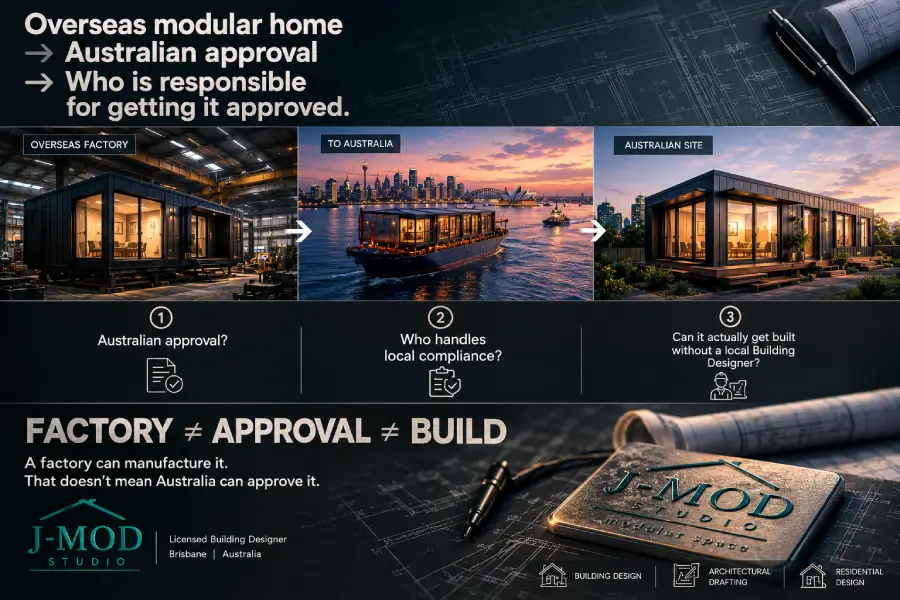
A factory product is not automatically an approved building
There is an important distinction between manufacturing a building and establishing that the building can be constructed and approved for a particular Australian site.
The National Construction Code sets minimum requirements for building work across Australia, while state and territory legislation, planning frameworks and approval processes also apply. The ABCB’s guidance on prefabricated, modular and off-site construction specifically identifies planning, building approvals, inspections and state or territory requirements as matters that sit alongside NCC compliance.
In Queensland, most domestic building work requires building approval before construction begins, with building certifiers involved in assessing approved plans and inspecting required stages of construction.
The Australian site changes the question
The site may have its own levels, access limitations, services, drainage, orientation, setbacks, planning considerations, structural requirements and other constraints.
Even a well-designed modular product may therefore need to be reviewed or adapted before it becomes appropriate for a particular location.
That is why “the factory can manufacture it” and “Australia can approve it for this site” are two different questions.
Who handles the gap between factory and site?
The important point is that different professionals have different roles.
Don't think backwards
Choose the factory.
Choose the design.
Pay the deposit.
Then ask how it will be approved.
SITE → DESIGN → FEASIBILITY → MODULAR SOLUTION → DOCUMENTATION → APPROVAL → CONSTRUCTION
Where does a local Building Designer fit?
It is to help bridge the space between what can be manufactured and what can be designed, documented and built for an Australian site.
FACTORY ≠ APPROVAL ≠ BUILD
Before asking how much the modular home costs, ask a more important question first:
What exactly is being designed, specified, documented and priced — and who is responsible for making it work in Australia?
J-MOD Studio
Licenced Building Designer | Brisbane, Australia
J-MOD Studio helps bridge the gap between modular manufacturing and Australian building design — supporting site-specific design, documentation and residential design considerations before a modular solution moves toward approval and construction.
Explore our modular space:
www.jmod.com.au
info@jmod.com.au