Before You Buy a Modular Home in Brisbane, Check What Can Actually Be Approved
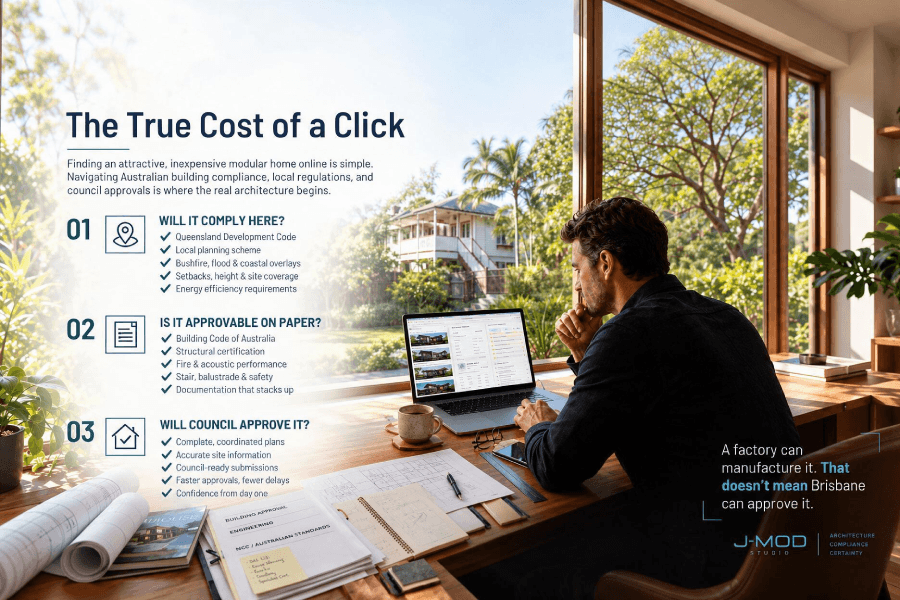
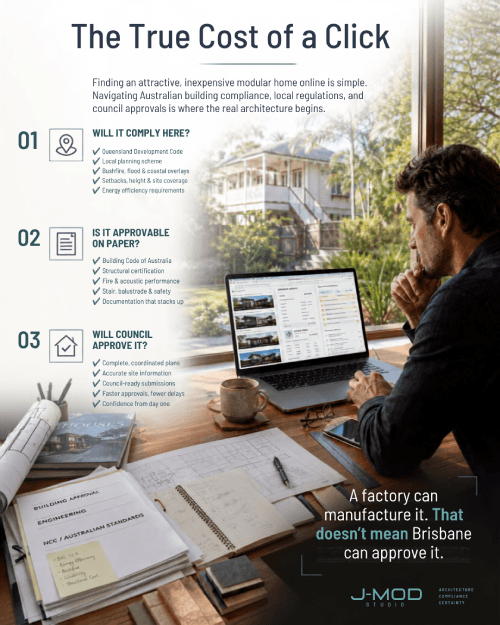
The True Cost of a Click
You see an attractive modular home online. The photography looks impressive. The floor plan makes sense. The advertised price catches your attention.
And naturally, the next question is: “How much?”
But for a Brisbane building project, there may be a more important question to ask first:
“Can this actually work on my site?”
That is where the difference between buying a product and developing a building project
becomes important.
A modular home is still a building project
A factory can manufacture a building to a particular design. But Brisbane does not approve a photograph, a website listing or a factory product in isolation.
The proposed building has to work within the requirements that apply to the actual property.
Brisbane City Council advises homeowners to establish key property information, including zoning and overlays, before starting a new house. Depending on the site and proposal, planning assessment may be triggered by matters such as flood, bushfire, coastal hazard, heritage, landslide or other overlays.
Approval is not one simple checkbox
For a new modular house in Brisbane, building approval is required, and Council states that this is organised through a licensed building certifier. Planning approval may also be required depending on the property and proposal.
In other words, “Will Council approve it?” is not always the complete question.
“What approvals and compliance requirements apply to this particular site and design?”
What exactly does the online price include?
The point is not that an advertised price is misleading. The point is that a product price and a completed, approved building project are not necessarily the same thing.
Perhaps the biggest mistake is starting in the wrong place
PRODUCT → PRICE → SITE → APPROVAL
SITE → REQUIREMENTS → DESIGN → FEASIBILITY → MODULAR SOLUTION→ DOCUMENTATION → APPROVAL → CONSTRUCTION
Instead of asking, “Which modular home is cheapest?”, the first questions become:
What can this site accommodate?
What requirements apply?
What needs to be documented?
What exactly is included in the supplier’s proposal?
Modular construction is not the problem
Modular construction can offer genuine advantages. Factory manufacturing can provide a controlled production environment and a different approach to construction.
The factory knows its product. The site has its own conditions. Brisbane has its own planning framework. Queensland has its own building requirements. The design documentation has to connect those pieces.
Start with the site, not the click
J-MOD Studio approaches modular projects from the Brisbane side of that gap — helping examine the relationship between the site, design, documentation and local requirements before a modular solution is treated as the finished answer.
Factory ≠ Approval ≠ Build.
Pause before you click “buy.”
It is what you discover after it.